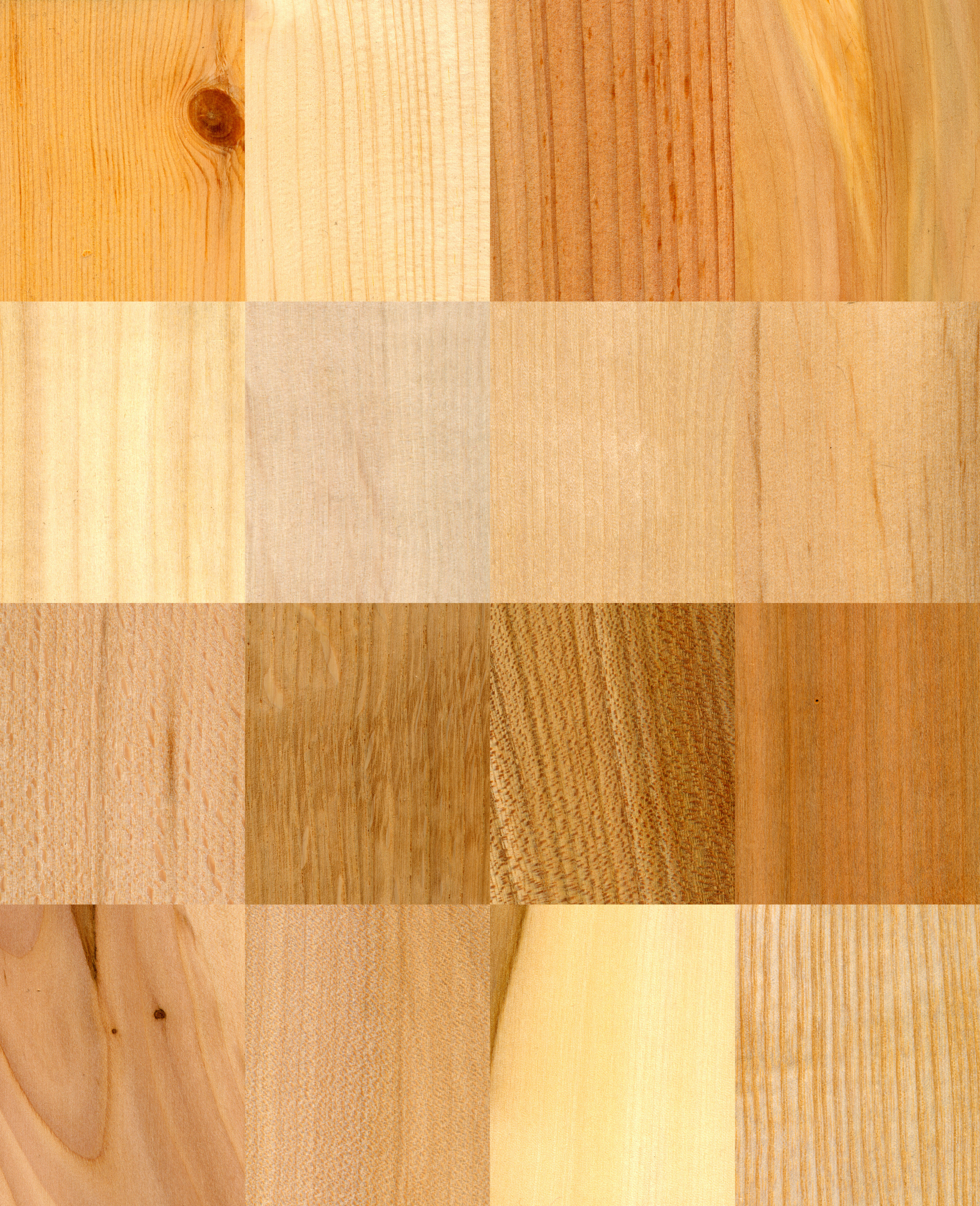
Wood and moisture in Canada
Wood is a hygroscopic material — it absorbs and releases moisture from the surrounding air until it reaches equilibrium with the ambient relative humidity. In Canada, the range of indoor relative humidity across seasons is among the widest in the world for a temperate climate. A wood-heated farmhouse in Saskatchewan might sit at 15–20% RH in January and 60–70% RH in August. Even in a climate-controlled urban home, the swing between a well-heated winter interior and a humid summer is typically 25–35 percentage points.
This matters for wood selection because different species respond differently to moisture change. The figure used to compare species is the tangential shrinkage coefficient — how much a piece of flat-sawn wood shrinks or expands across its width per percentage point change in moisture content. A species with a high tangential shrinkage value (such as red oak at around 0.37% per point of moisture change) will move significantly more than one with a lower value (like white cedar at roughly 0.14%).
Practically, this means that a wide tabletop made from flat-sawn red oak in a dry Canadian workshop needs to be built with movement in mind — the top should be attached with buttons or elongated slots rather than screws, and it should not be expected to stay perfectly flat through the winter-to-summer humidity cycle.
Lumber purchased from a retailer is typically dried to 6–8% moisture content (kiln-dried) or air-dried to regional ambient levels. Before machining, store the wood in the space where the finished piece will live for at least one to two weeks, allowing it to reach equilibrium with that specific environment. In a dry heated interior, wood from a damp retail yard can lose several percentage points of moisture in a week, causing significant movement.
Common hardwoods in Canadian retail
Hard maple (Acer saccharum)
Hard maple is one of the most widely available domestic hardwoods in eastern Canada, particularly in Ontario and Quebec where it grows in abundance. It is the standard material for flooring and butcher block countertops, and its availability at both hardwood specialty retailers and large home improvement stores makes it accessible to most workshop operators in the region.
It machines well when tools are sharp, but requires very sharp edges — dull cutters cause burnishing and tear-out. The grain is typically fine and straight, though curly and bird's eye figures occur. Hard maple takes water-based finishes without grain raise issues and accepts stain, though it is prone to blotching with pigment stains on soft maple; pre-conditioner helps.
Yellow birch (Betula alleghaniensis)
Yellow birch is structurally similar to hard maple and often found in the same retail outlets. It is slightly more forgiving to machine — tear-out is less of a concern — and responds well to both oil-based and water-based finishes. The heartwood is a warm yellowish-tan; the sapwood is cream-white. It is often used where maple might be used, particularly in cabinetry and furniture intended for painted or stained finishes.
Red oak (Quercus rubra)
Red oak is widely available across Canada, frequently found in pre-dimensioned boards at building centres. Its open-pored ring-porous grain structure makes it distinctive — the medullary rays produce a characteristic fleck figure on quartersawn surfaces. Red oak is relatively easy to work with both hand and machine tools, though its large pores require grain filling before applying a smooth film finish.
Red oak has a significant tangential shrinkage value and moves considerably in the seasonal humidity cycle typical of Canadian interiors. Solid red oak panels wider than about 200mm (8 inches) flat-sawn should be designed to accommodate movement. Quartersawn red oak moves roughly half as much in width.
Black walnut (Juglans nigra)
Black walnut is the premium domestic hardwood most sought after by Canadian furniture makers. It is reasonably available in Ontario and Quebec but becomes expensive and harder to find further west. The heartwood is a rich brown-purple that lightens with age and UV exposure. It machines beautifully with sharp tooling, takes a wide range of finishes, and requires no grain filling despite its open pores — the visual character of the grain is typically left visible.
One practical note: walnut contains juglone, a compound that inhibits the germination and growth of some plants. Walnut sawdust in garden beds can damage nearby plants. In a workshop context, this is mainly a consideration for cleanup and disposal.
White ash (Fraxinus americana)
White ash has a pronounced ring-porous grain similar to oak, and its strength-to-weight ratio makes it a traditional choice for tool handles and sporting equipment. It steam-bends exceptionally well. In furniture, ash is most common in chair legs and structural members where its resilience to impact loading is an advantage. The supply situation for ash has changed significantly across eastern Canada due to the ongoing spread of the emerald ash borer — locally cut ash may be available at lower cost in affected areas, but buyers should confirm that material has been properly dried and inspected.
Common softwoods
Western red cedar (Thuja plicata)
Western red cedar is the default outdoor wood across British Columbia and the Pacific coast. Its natural resistance to decay makes it the standard choice for decking, siding, and outdoor furniture. In an interior context, it is used for closet linings (the aromatic oils are a natural moth deterrent), carved decorative work, and lightweight panels. It is very soft by hardwood standards — it dents easily — and should not be used where surface durability is required.
Douglas fir (Pseudotsuga menziesii)
Douglas fir is the dominant structural softwood in western Canada and is readily available at building centres in the west. For furniture use, clear grades (select or better) are required — construction grades contain knots that interrupt the grain and reduce strength in furniture members. Clear Douglas fir has a distinctive straight, even grain and machines and finishes well. It is substantially harder than cedar and appropriate for flooring, stair treads, and furniture in a workshop where western softwoods are more accessible than eastern hardwoods.
Eastern white pine (Pinus strobus)
Eastern white pine was the dominant furniture and building wood in Canada through the 18th and 19th centuries, and antique pieces in this species are common. It is soft, easy to work by hand, and was traditionally used for painted furniture — many surviving pieces with layers of historic paint are white pine. For new work, it remains available at reasonable cost, though wide, clear stock is increasingly expensive. It is not suitable where surface hardness is needed; a chair seat in white pine will dent and scratch in normal use.
Grading and moisture content
Canadian lumber is graded by the National Lumber Grades Authority (NLGA) for softwoods and by individual associations for hardwoods — hardwood grading in North America generally follows the National Hardwood Lumber Association (NHLA) rules, which grade by the percentage of usable (clear) material in a board.
For furniture work, FAS (Firsts and Seconds) and F1F (Firsts one face) are the standard furniture grades. These guarantee that a specified percentage of the board surface is clear of defects. Select and No. 1 Common grades contain more character (knots, mineral staining) and are appropriate for pieces where some natural variation is acceptable or desirable.
Moisture content of kiln-dried hardwood should be between 6 and 8% for furniture intended for a heated Canadian interior. Ask for a moisture meter reading when purchasing from a specialty retailer. Large home improvement centres may not be able to provide this, and their stock varies — check the board ends for checking (small cracks) that indicate the wood has been through multiple wet-dry cycles.
External references
- Canadian Woodworking — species guides and regional sourcing information.
- Wood Magazine — detailed species profiles with workability ratings.
- Popular Woodworking Magazine — practical wood selection guides for furniture making.